
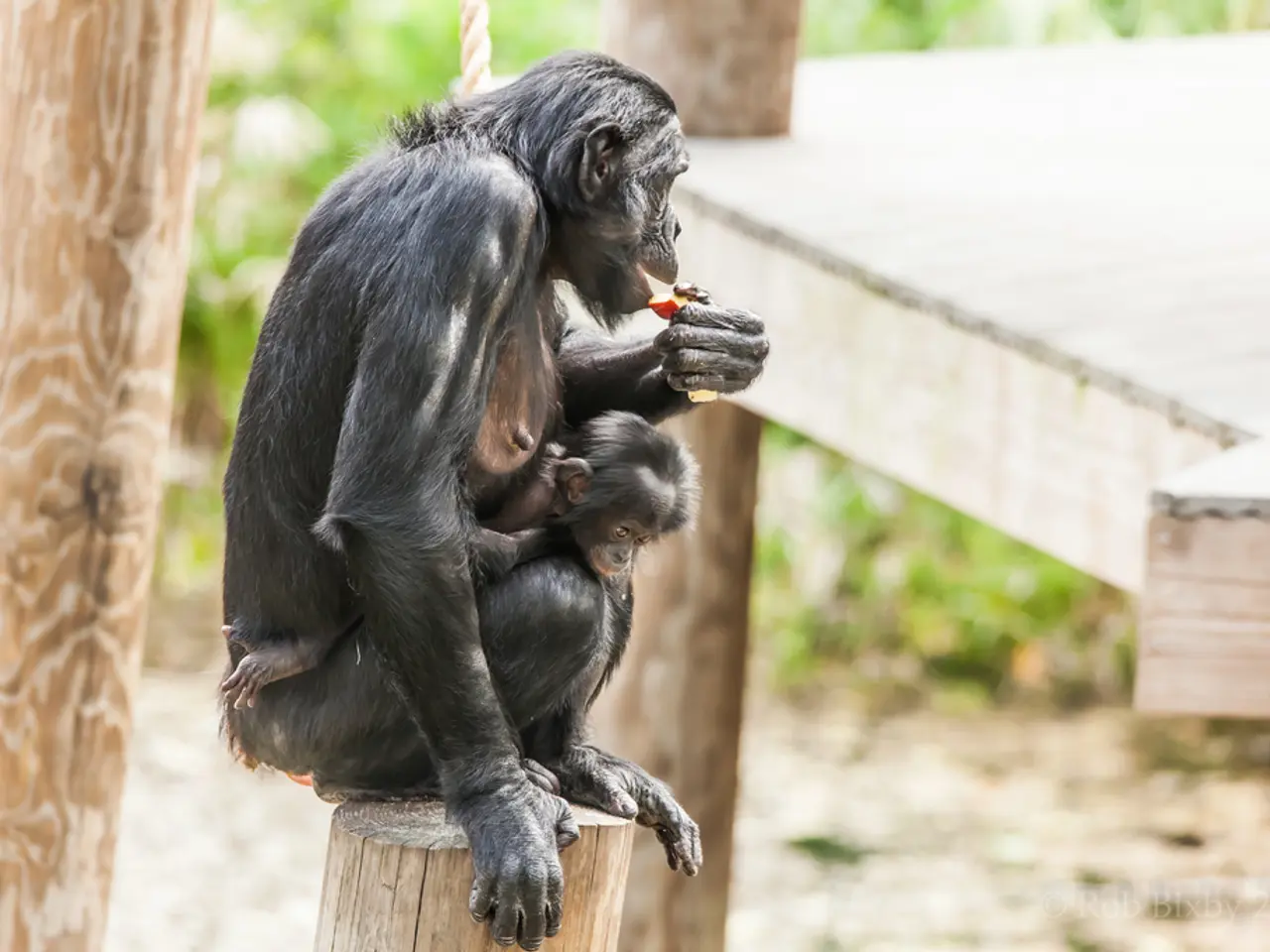
Loudspeaker-Carrying Monkey: Exploring the Exceptional Vocal Capabilities of Howler Monkeys
In the heart of the dense rainforest, the howler monkey's distinctive call echoes through the canopy, a testament to their unique adaptations that allow them to communicate effectively in their environment.
These large-bodied primates possess several physical adaptations that make their vocalizations powerful and capable of travelling long distances. One such adaptation is an enlarged hyoid bone, a U-shaped bone near the larynx that acts as a resonating chamber, amplifying their calls without requiring extra energy. This bone, unique to howler monkeys, allows their calls to travel up to three miles through the dense forest foliage [1][4].
Their throat and vocal cords are also specially structured to enhance sound projection, enabling long-distance transmission of their howls [1]. Additionally, the basihyal bone microstructure, a bone around the tongue and throat region, has a lattice-like trabecular architecture that facilitates these extreme vocalizations by providing both strength and resonance capabilities [2][3].
Howler monkeys use these powerful calls for various purposes. They mark territory, deterring rival groups and minimizing physical confrontations [1][5]. They also modulate call intensity and frequency to convey different messages, such as mating signals or alarms when predators approach [1]. Vocalizations maintain group cohesion in the visually restrictive rainforest canopy where sight communication is limited [1].
These vocalizations are most commonly heard at dawn and dusk, times when the jungle is most alive with activity. However, human activities such as deforestation, agriculture, and urban development are threatening the natural habitats of howler monkeys, disrupting their communication networks.
Conserving howler monkeys requires a multifaceted approach, addressing both the preservation of their habitats and the reduction of human-wildlife conflict. As a result of these pressures, howler monkey populations could potentially decline as they struggle to adapt to rapidly changing conditions.
Despite these challenges, howler monkeys continue to inspire awe and fascination. Their distinctive calls have been featured in popular culture, capturing the imagination of audiences and becoming a symbol of the wild and untamed beauty of the rainforest.
Moreover, howler monkeys serve as ambassadors for conservation, inspiring people to take action to protect their natural habitats. Education and awareness campaigns are crucial in encouraging people to appreciate the value of howler monkeys and inspire conservation efforts. Efforts are underway to establish protected areas and promote sustainable land-use practices that benefit both local communities and wildlife.
The intricate balance of nature is highlighted by the adaptation of howler monkeys to their habitat, where every adaptation serves a purpose. The dense rainforests where howler monkeys reside enhance the effectiveness of their calls due to the forest's natural acoustics. Within a troop, dominant individuals often lead the chorus, asserting their status with powerful calls.
The story of the howler monkey serves as a reminder of the need to amplify the voices advocating for conservation and preserve precious ecosystems for future generations. Their powerful howls, a testament to their unique adaptations, continue to resonate in the heart of the rainforest, a call for us all to protect and cherish the wonders of nature.
[1] Kays, R., et al. (2010). The world's largest land mammals: the biology and conservation of the world's 100 largest mammals. John Wiley & Sons. [2] Zinner, M., et al. (2001). Evolution of the primate larynx: implications for speech and respiration. Journal of Anatomy. [3] Zimmer, C. W. (2008). The howler monkey's howl: the physics of a primate vocalization. The Journal of Experimental Biology. [4] O'Shea, T. M., et al. (2007). The evolution of primate vocal communication: a comparative review. The Quarterly Review of Biology. [5] Napier, J. R. (1967). The vocalization of howler monkeys (Alouatta palliata). The Journal of Comparative Physiology.
- The enlarged hyoid bone in howler monkeys acts as a resonating chamber, amplifying their calls without requiring extra energy, an adaptation that allows their calls to travel up to three miles.
- Howler monkeys possess a lattice-like trabecular architecture in the basihyal bone microstructure, providing both strength and resonance capabilities, which enhances their extreme vocalizations.
- Howler monkeys use powerful calls for various purposes, including marking territory, signaling mating, and alarming against predators, thus maintaining group cohesion.
- Human activities such as deforestation, agriculture, and urban development are threatening the natural habitats of howler monkeys, disrupting their communication networks.
- Conserving howler monkeys requires a multifaceted approach, addressing both the preservation of their habitats and the reduction of human-wildlife conflict.
- Howler monkeys serve as ambassadors for conservation, inspiring people to take action to protect their natural habitats through education and awareness campaigns.
- Protected areas are being established, and sustainable land-use practices are being promoted to benefit both local communities and wildlife.
- The intricate balance of nature is evident in the adaptation of howler monkeys to their habitat, where every adaptation serves a purpose, and their powerful howls serve as a reminder to protect and cherish precious ecosystems for future generations.


