
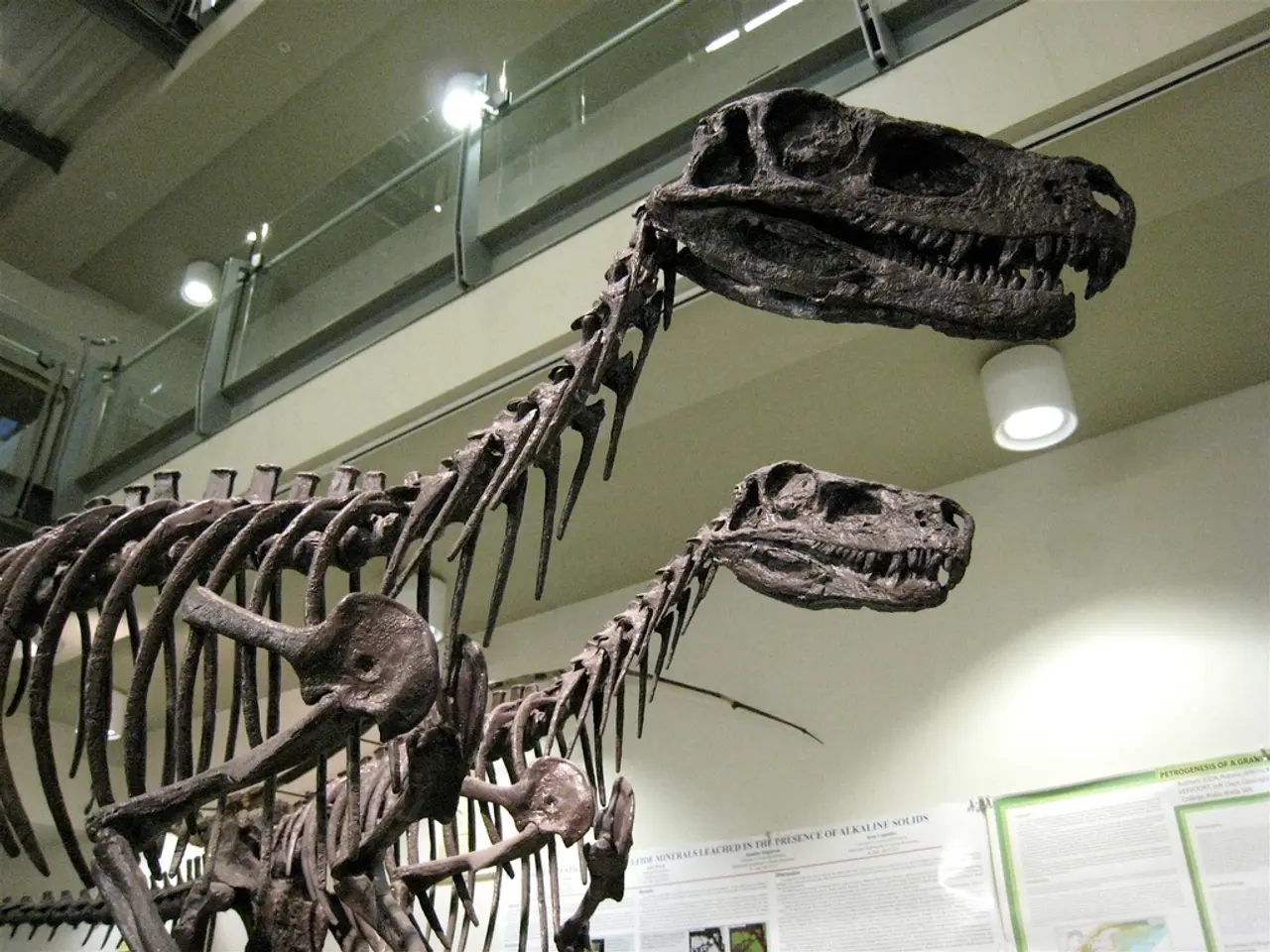
Dinosaur with Protruding Spines: An Enigma Unraveled
In the vast expanse of Patagonia, the fossilized remains of a peculiar herbivore named Bajadasaurus pronuspinax have been unearthed, offering fascinating insights into the survival strategies of prehistoric creatures.
The most striking feature of Bajadasaurus pronuspinax was its elongated and forward-curving neural spines on the cervical vertebrae, a unique anatomical trait that sets it apart within the diplodocoid sauropods. These spines, reminiscent of weapons forged from bone, were not merely decorative.
Researchers believe that these spines served a primary defensive purpose, acting as a deterrent against predators. The forward-curving shape and length of the spines could have protected vulnerable parts of the neck from attacks, creating a protective barrier or making the neck appear more formidable.
Furthermore, it has been proposed that these spines might have supported a sail-like structure of skin or keratinous sheathes. Such structures could have been used for display purposes, species recognition, or thermoregulation. However, the defensive function is considered more likely.
The unusual morphology of these spines provides insight into the diversity of defensive and display adaptations among sauropods. Bajadasaurus pronuspinax, with its extreme neural spines, represents an intriguing example of evolutionary innovation within sauropod dinosaurs, coping with predation pressures.
The only known fossil of Bajadasaurus pronuspinax was discovered near the Limay River in Patagonia at a site called Bajada Colorada. This fossil preserved key features of the skull and spine, allowing for a detailed reconstruction of its anatomy and possible lifestyle.
Bajadasaurus pronuspinax belonged to the group of dinosaurs called dicraeosaurids, which were small sauropods with short necks, long tails, and skeletal innovations. It shared similarities with Amargasaurus, another spiny-necked sauropod from South America, but had even longer, more exaggerated vertebrae.
Today, a life-sized replica of Bajadasaurus pronuspinax can be found at the Cultural Science Centre in Buenos Aires, offering a glimpse into the bizarre world of prehistoric life. The study of Bajadasaurus pronuspinax continues to uncover evidence of how prehistoric creatures used physical traits in creative ways to survive.
In a world ruled by predators, Bajadasaurus pronuspinax thrived not through aggression, but through innovation. Its skeleton tells a story of a creature that used its body as a shield, a signal, and a system for surviving in a world where being strange was sometimes the best strategy of all.
- The unique anatomical trait of Bajadasaurus pronuspinax, its elongated and forward-curving neural spines, offers fascinating insights into the evolution of defensive adaptations in environmental-science, particularly within the context of prehistoric creatures and their survival strategies.
- The discovery of Bajadasaurus pronuspinax, a spiny-necked sauropod from Patagonia, has shed light on the diverse ways in which life in the past might have been influenced by medical-conditions, such as predation pressures, as evident from its skeletal innovations.
- As we continue to study Bajadasaurus pronuspinax, we gain a deeper understanding of how lifestyle and physical traits can intertwine in education-and-self-development, providing us with insights into the intricate web of life that existed millions of years ago.
- Advancements in technology have enabled researchers to replicate life-sized models of extinct creatures like Bajadasaurus pronuspinax, bringing the bizarre world of space-and-astronomy and general-news closer to our own lifestyles.
- The story of Bajadasaurus pronuspinax, a creature that thrived in the face of predators through innovation rather than aggression, serves as a reminder of the adaptability and resilience of life on our planet, a testament to the wonders of science and the beauty of the world, both in the past and the present.


